Physics › Waves
Waves
Oscillations that travel, and the interference, diffraction and standing-wave patterns they produce when they meet each other or an obstacle.
Year 12 · 8 topics.
- Progressive waves
- Longitudinal, transverse and polarisation
- Stationary waves
- Refraction and total internal reflection
- Diffraction and the single slit
- Interference and Young's double slit
- Diffraction gratings
- Lenses and images
What waves covers
Oscillations that travel, and the patterns they produce when they meet each other, a boundary or a gap. Superposition is the idea the unit is built around, and it returns later in electron diffraction and in astronomy. Two AQA required practicals sit here, on stationary waves and on interference, so the measurement technique is examinable too.
The main ideas
- Amplitude, wavelength, frequency, period and phase difference, and the difference between a displacement-distance and a displacement-time graph.
- Transverse against longitudinal, and polarisation as evidence that light is transverse while sound in air is not.
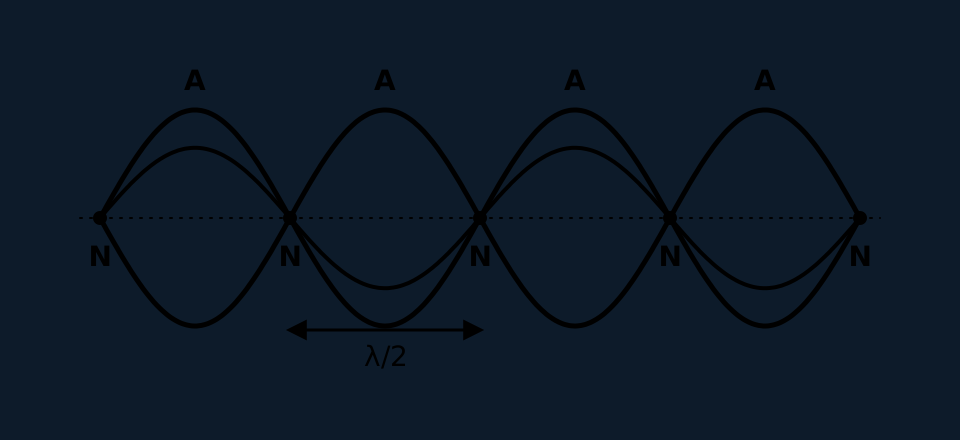
- Stationary waves: nodes, antinodes, their spacings, and the harmonics of a string and of open and closed air columns.
- Refraction, Snell's law, the critical angle and total internal reflection, with optical fibres as the application.
- Diffraction at a single slit, and what slit width and wavelength do to the pattern.
- Two-source interference: path difference, coherence and fringe spacing, then the grating with its orders.
- Lenses, ray diagrams and the thin lens equation.
The equations it turns on
- the wave equation, and period from frequency
- refraction, and the critical angle
- fringe spacing in Young's double-slit experiment
- the grating, with d from the lines per millimetre
- allowed stationary-wave wavelengths
- the thin lens equation, and power in dioptres
Where it usually goes wrong
- A stationary wave is not a wave that has stopped. It is two waves travelling in opposite directions, it transfers no energy along the medium, and every point within one loop oscillates in phase.
- Waves diffract at any gap. The spreading is greatest when the gap is comparable with the wavelength, not only when it is smaller.
- In the critical angle formula the smaller refractive index goes on top, and the light has to start in the denser medium.
- The three lengths in w = lambda D / s arrive in nanometres, millimetres and metres, and converting all three first prevents most lost marks here.
Where to start
Progressive waves first for the vocabulary, then longitudinal and transverse, then stationary waves. Take diffraction, the double slit and gratings in that order, since each uses the one before. Lenses is self-contained and can be taken at any point.