Physics › Quantum phenomena
Quantum phenomena
The experiments that broke classical physics: light arriving in lumps, and electrons behaving like waves.
Year 12 · 4 topics.
- The photoelectric effect
- Collisions of electrons with atoms
- Energy levels and photon emission
- Wave-particle duality
What quantum phenomena covers
The observations classical wave theory could not account for, and the photon model that replaced it. Four lessons only, but examined heavily, because the arguments carry as many marks as the arithmetic. Everything here reappears in particles, in nuclear physics and in the turning points option.
The main ideas
- The photoelectric observations a wave model cannot explain, particularly the threshold frequency and the instant emission above it.
- Work function, threshold frequency and stopping potential, with the photoelectric equation applied as an energy budget for one electron.
- The graph of maximum kinetic energy against frequency, whose gradient is the Planck constant and whose intercepts give the work function and threshold.
- Excitation against ionisation in electron-atom collisions, and how a fluorescent tube uses both.
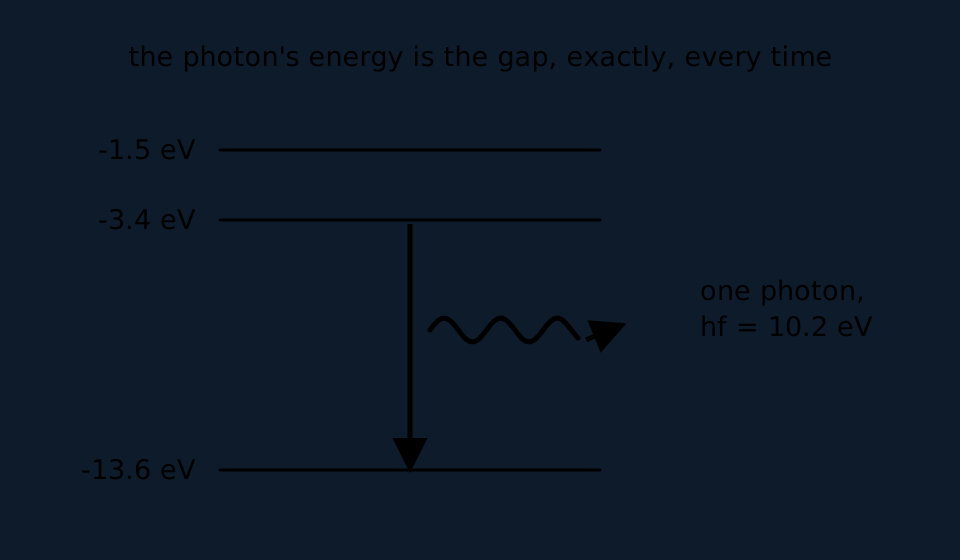
- Line spectra as evidence for discrete energy levels, and the transition equation for an emitted photon.
- Wave-particle duality: electron diffraction as evidence for matter waves, and the de Broglie wavelength.
The equations it turns on
- the energy of a photon
- the photoelectric equation
- the photon emitted as an electron drops between levels
- the de Broglie wavelength of a particle
- the conversion nearly every question here needs
Where it usually goes wrong
- Brighter light delivers more photons, not more energetic ones. Below the threshold frequency no intensity produces emission, and the unit is built to test that point.
- Energy levels are negative, with zero at ionisation, so a transition energy is a subtraction of two negatives and the signs have to be written out.
- The de Broglie wavelength needs a momentum, so a question giving an accelerating pd expects the speed from eV = half m v^2 first.
- Work functions come in electronvolts and photon energies in joules, and mixing the two is the commonest error in this unit.
Where to start
The photoelectric effect first, since it introduces the photon and holds most of the marks. Collisions of electrons with atoms and energy levels then work as one idea seen twice. Wave-particle duality last, because it sets that evidence against electron diffraction.