Physics › Nuclear physics
Nuclear physics
Inside the nucleus: radioactive decay, binding energy, and the physics of fission and fusion.
Year 13 · 6 topics.
- Rutherford scattering and the nuclear atom
- Radioactive decay and half-life
- Nuclear radius and density
- Mass-energy and binding energy
- Fission and fusion
- Nuclear reactors and safety
What nuclear physics covers
The evidence for a small, massive nucleus, then radioactive decay, nuclear size and density, binding energy, and the two ways of releasing energy from nuclei. It reuses the exponential mathematics from capacitance and the inverse-square law from fields. AQA's required practical 12 on gamma radiation is examined here.
The main ideas
- The alpha scattering results, and the argument from them to a nucleus that is small, massive and positive.
- Alpha, beta and gamma identified by absorption, with their compositions, ranges, hazards and uses, and the inverse-square law for gamma.
- Decay as a random process, activity and the decay constant, the exponential law, and half-life from a decay curve or a log graph.
- Predicting a decay mode from a nuclide's place on the neutron against proton graph, and writing balanced decay equations.
- Nuclear radius from closest approach and from electron diffraction, and the cube-root law that makes nuclear density the same for every nucleus.
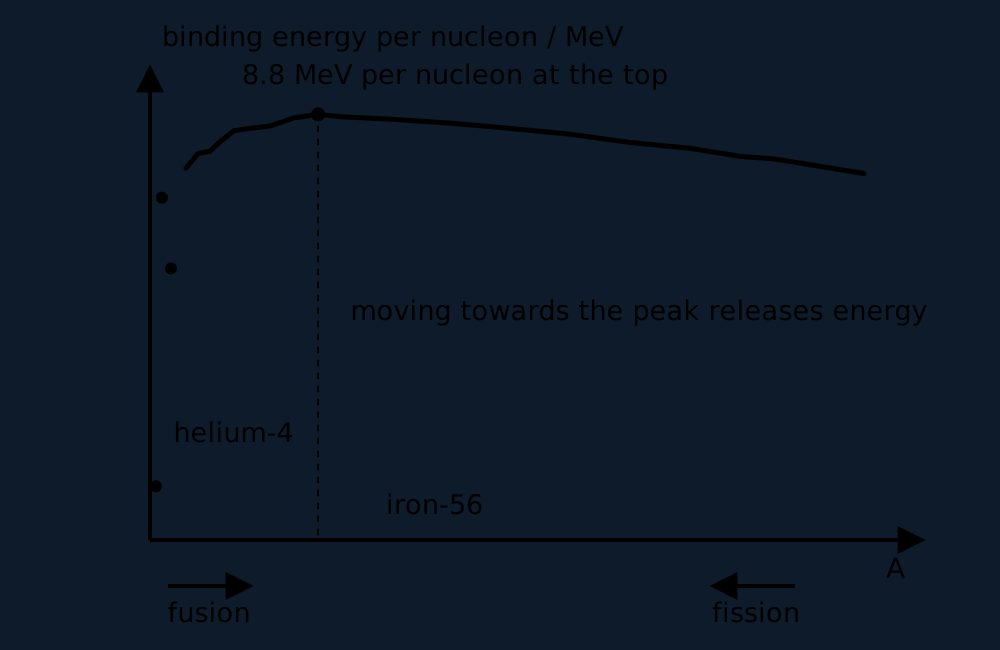
- Mass difference, binding energy, binding energy per nucleon and the shape of its curve.
- Induced fission, the chain reaction and critical mass, then the moderator, control rods, coolant and the safety case of a reactor.
The equations it turns on
- activity from the decay constant and the number of nuclei
- the decay law, in nuclei, activity or corrected count rate
- converting between half-life and decay constant
- nuclear radius from nucleon number
- converting a mass difference into an energy
- the inverse-square law for a gamma source
Where it usually goes wrong
- Half-life and decay constant have to be converted first, and the half-life must be in seconds if the activity is to come out in becquerels.
- A mass in grams has to become a number of nuclei through the molar mass and the Avogadro constant before A = lambda N can be used.
- Binding energy is the energy to separate a nucleus into nucleons, and the mass difference is the parts minus the whole. Energy is released when the products sit higher on the binding energy per nucleon curve, which is why fission suits heavy nuclei and fusion light ones.
- Background count rate must be subtracted from every reading before an inverse-square check, since the background does not fall with distance.
Where to start
Rutherford scattering first for the evidence, then radioactive decay and half-life, the longest and most examined lesson. Nuclear radius next, then binding energy, which fission and fusion both depend on. Reactors last, since that lesson is mostly description.