Physics › Magnetic fields
Magnetic fields
Moving charge creates magnetism, and changing magnetism moves charge: the physics behind motors, generators and transformers.
Year 13 · 7 topics.
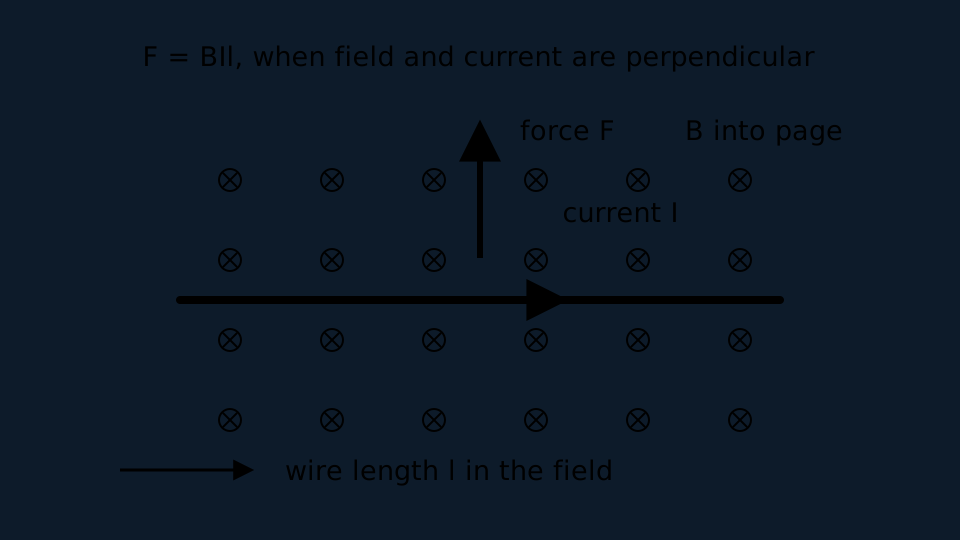
- Magnetic flux density and the force on a wire
- Force on a moving charge
- Magnetic flux and flux linkage
- Electromagnetic induction: Faraday and Lenz
- Alternating currents
- Rectification and smoothing
- Transformers
What magnetic fields covers
Moving charge experiences a force in a magnetic field, and changing magnetic flux produces an electromotive force. This is the largest Year 13 core unit, running from the force on a single wire through to the national grid. Two required practicals sit in it, on the force on a current-carrying wire and on the search coil.
The main ideas
- The force on a current-carrying wire, Fleming's left hand rule, and the definition of flux density and the tesla.
- The force on a single moving charge, the circular path it produces, and why a magnetic force does no work.
- Magnetic flux through an area, flux linkage for N turns, and the angle measured to the normal.
- Faraday's law for the size of an induced emf and Lenz's law for its direction, justified by conservation of energy.
- The uniformly rotating coil and the alternating output it produces.
- Alternating current: peak, peak-to-peak and root mean square values, read off an oscilloscope.
- Rectification with a diode bridge, smoothing with a reservoir capacitor, and transformers with their losses and the case for high-voltage transmission.
The equations it turns on
- the force on a current-carrying wire
- the force on a moving charge, and its circular path
- flux through an area, and linkage for a rotated coil
- Faraday's law, with Lenz's law fixing the direction
- root mean square value of a sinusoidal supply
- the transformer turns-ratio equation
Where it usually goes wrong
- The angle in BAN cos theta is between the field and the normal to the coil, not the plane of it. Face-on gives maximum linkage, edge-on gives zero.
- A magnetic force is always perpendicular to the velocity, so it changes direction and never speed. A particle gains no kinetic energy from it.
- The induced emf is largest when the flux linkage is changing fastest, which is the moment the linkage itself passes through zero. That quarter-cycle offset is a standard exam point.
- Transmission loss is the current squared times the cable resistance, so raising the voltage cuts the current and the loss falls with its square. A transformer cannot increase power.
Where to start
The force on a wire and the force on a moving charge work as one pair. Flux and flux linkage must come before induction, since Faraday's law is stated in terms of them. Alternating currents, rectification and transformers form the applied group at the end.